
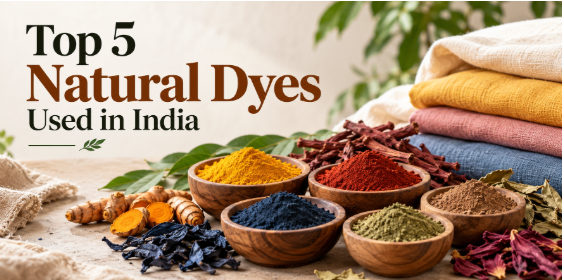

India has a long history of textile dyeing using colourants derived from plants, roots, leaves, and fruit rinds. These materials have helped artisans develop the indigo blues, earthy reds, warm yellows, and muted browns associated with traditional Indian textiles. Their use continues in contemporary fabric development, where colour, material choice, and production methods influence a textile’s appearance and character.
The five natural dyes explored here are indigo, madder, turmeric, pomegranate rind, and myrobalan. Each offers distinct colouring properties and requires specific processing techniques to achieve the desired shade. For businesses developing textile collections, sourcing natural dyes from suppliers committed to responsible sourcing and sustainable practices can be a practical starting point for more considered fabric dyeing.
1. Indigo
Indigo is one of India’s best-known natural textile dyes, valued for its distinctive blue shades. It is traditionally obtained from plants such as Indigofera tinctoria. Its history is closely associated with Indian textile production, including blue fabrics and resist-dyed patterns created by traditional artisans.
Unlike many plant-based dyes, indigo requires a reduction process to make the colourant soluble in the dye bath. Once the fabric is removed and exposed to oxygen, the characteristic blue develops. Repeated dips can build colour depth, allowing dyers to achieve different shades depending on the process.
Indigo is used in cotton fabrics, handloom textiles, and traditional patterned cloth. It is particularly relevant to designs that rely on blue contrasts, repeated motifs, or the visual depth of layered dyeing. The final shade and colourfastness depend on the fibre, dyeing technique, and after-treatment.
2. Madder
Madder, commonly associated with Rubia cordifolia, also known as manjistha, is a traditional source of red colour in Indian textiles. Its roots contain colouring compounds that can produce shades ranging from pink and terracotta to deeper reds, depending on the dye bath and mordant.
A mordant is a substance used to help a dye interact with fibres or influence the colour produced. Alum and iron compounds, for example, can affect the shade obtained from madder. Fibre preparation, temperature, and dye concentration also influence the result.
Madder is suited to textiles where warm red tones and earthy colour palettes are central to the design. It has historical relevance in printed and dyed fabrics, although reproducing a specific shade consistently requires careful control of the process.
3. Turmeric
Turmeric, or haldi, is a familiar Indian botanical dye source that produces bright yellow and golden shades. The colouring compound curcumin gives turmeric its characteristic yellow appearance. Its accessibility has made it relevant to traditional dyeing practices and small-scale textile experiments.
However, turmeric has an important limitation: its colour can fade with exposure to light and repeated washing. A vivid yellow sample may therefore behave differently from a textile intended for regular wear or prolonged display.
Turmeric is useful when exploring warm yellow palettes, craft projects, and experimental natural dyeing. For commercial garments, dyers should test the finished fabric under expected washing and light conditions rather than judging performance by the initial colour alone.
4. Pomegranate Rind
Pomegranate rind is a source of tannins and natural colouring compounds used in traditional textile dyeing. Depending on the preparation and dyeing conditions, it can produce yellow, ochre, beige, and brown tones.
Tannins are particularly useful in textile processing because they can interact with fibres and metal salts, influencing colour development and dye uptake. Pomegranate rind may also be used alongside other dye sources to modify the final shade.
Its muted palette makes it relevant to earthy colour schemes, understated apparel, and craft-led textile collections. As with other botanical natural dyes, the outcome depends on the fibre, extraction method, mordant, and finishing process.
5. Myrobalan
Myrobalan, obtained from the fruit of Terminalia chebula, is an important material in traditional Indian textile dyeing. It contains tannins and is frequently used to prepare fabric before dyeing or printing, particularly in processes that require improved interaction between the fibre and subsequent colourants.
Myrobalan can contribute yellowish or earthy tones, but its importance extends beyond the colour it produces independently. In some traditional dyeing systems, it serves as a tannin-rich preparation material that helps other dyes develop their intended shades.
It is particularly relevant to craft traditions involving natural dyes and patterned textiles. The results depend on the preparation, fibre type, other dye ingredients, and processing sequence.
How Do Natural Dyes Affect Textile Colour and Quality?
The dye source is only one part of the process. Fibre composition, fabric construction, preparation, mordant selection, dye concentration, and finishing all influence the final result.
| Factor | Why it matters |
| Fibre composition | Cotton, linen, wool, and other fibres can respond differently to the same dye bath. |
| Fabric preparation | Scouring and other preparation steps affect how evenly colour develops. |
| Mordant selection | Certain mordants influence dye bonding, shade, and colour development. |
| Dye concentration | Changes in concentration and repeated dyeing can alter colour depth. |
| Colourfastness | Washing and light exposure can affect how well the colour is retained. |
For businesses developing naturally dyed collections, working with a wholesale fabric manufacturer in India can help align fabric selection with dyeing requirements, production volumes, and quality expectations.
Natural dyes should not automatically be considered colourfast or environmentally preferable in every application. Their overall impact also depends on how the raw materials are sourced, the water and energy used, the mordants selected, and the treatment of wastewater.
For textile businesses, testing samples before bulk production is essential. Wash-fastness and light-fastness assessments can help establish whether a particular dye and fabric combination is appropriate for the intended use.
Sourcing Naturally Dyed Fabrics for Commercial Use
Fashion labels, designers, and textile businesses need to consider more than the dye itself when developing a collection. The base fabric, desired shade, production volume, and consistency between batches all influence sourcing decisions.
Before placing an order, clarify the fabric composition, available dyeing services, sampling requirements, minimum order quantities, and expected production timelines. It is also useful to establish how shade variations between batches will be managed, particularly when the collection requires consistent colours across multiple garments.
Suvetah offers natural dyeing services for fabric development, including colour selection and customisation options. Its process allows buyers to select an available fabric or submit their own material, subject to suitability for the chosen dyeing method. Sampling and production requirements should be confirmed before proceeding with a commercial order.
Ultimately, natural dye selection involves balancing colour, material compatibility, production requirements, and performance. Understanding these factors helps designers and businesses make more informed decisions when incorporating naturally dyed textiles into their collections.
Frequently Asked Questions
What are the most commonly used natural dyes in India?
Indigo, madder, turmeric, pomegranate rind, and myrobalan are important natural dye sources associated with Indian textile traditions. They produce different colours and can serve different purposes within a dyeing process.
Are natural dyes suitable for cotton fabrics?
Yes, natural dyes can be used on cotton, but the results depend on the dye source, fabric preparation, mordant, and dyeing method. Testing is necessary to assess colour development and fastness.
Do natural dyes fade over time?
Some natural dyes are more susceptible to fading than others. Turmeric, for example, is known for limited lightfastness. Washing conditions, sunlight exposure, fibre type, and dyeing technique also influence colour retention.
Can natural dyes be used for commercial fabric production?
Yes. Natural dyeing can be used for commercial textiles, provided the process is evaluated for the intended fabric, shade, production volume, and quality requirements. Sampling and colourfastness testing help establish whether the result is suitable for the final application.
What should businesses check before ordering naturally dyed fabrics?
Businesses should review fibre composition, shade consistency, colourfastness, dyeing methods, minimum order quantities, and production timelines. They should also ask about mordants, wastewater management, and supporting documentation when evaluating environmental claims.